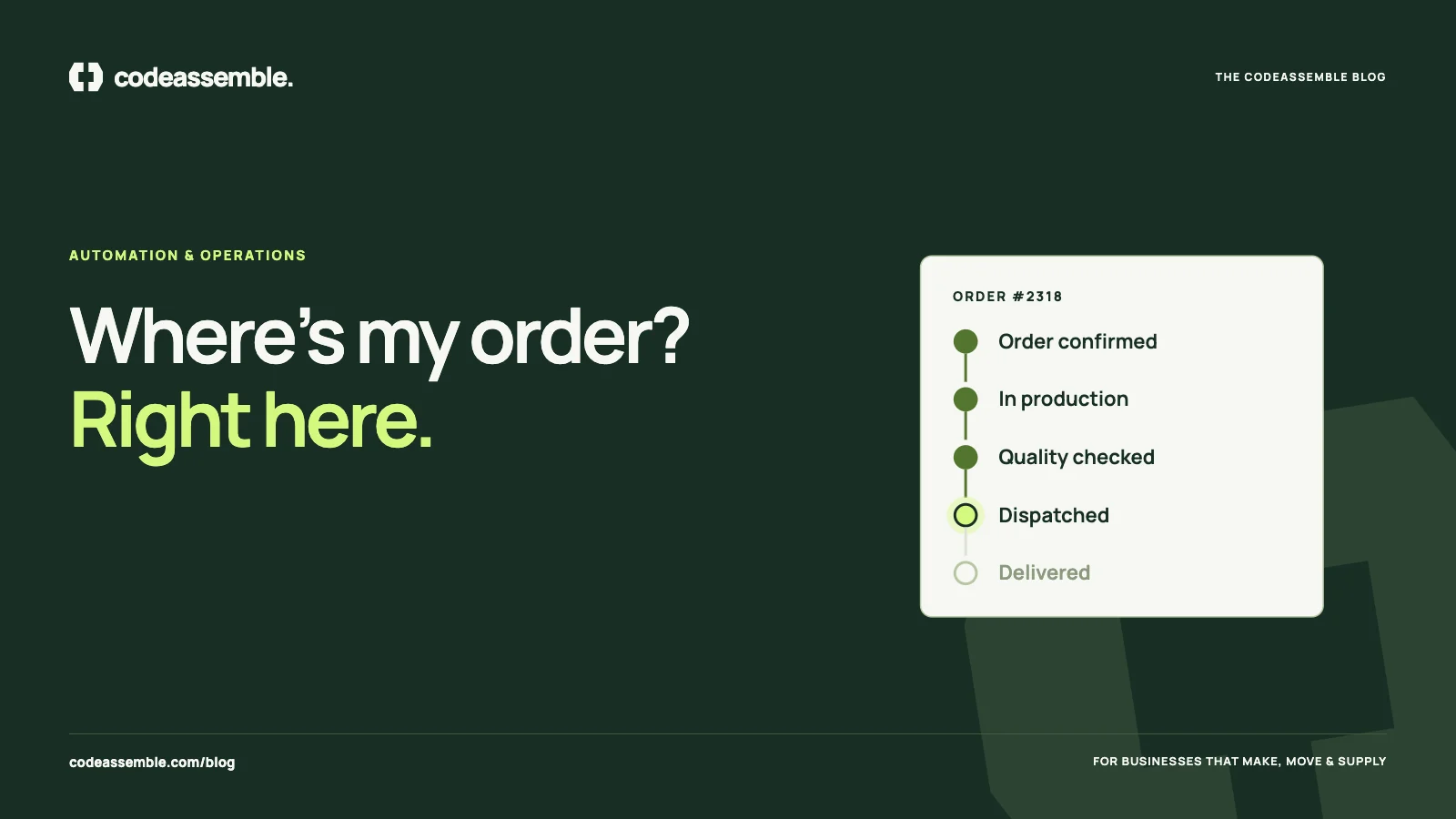
If your team takes regular calls, emails and messages asking “where’s my order?”, you’re not alone. In manufacturing, wholesale and distribution, status questions are among the most common customer contacts. Each one interrupts someone, who then has to check with production or dispatch, find the answer and reply.
These calls aren’t really a customer service problem. They’re a visibility problem. Customers ask because they can’t see. And often, your own team can’t see easily either.
Why status calls happen
- No proactive updates: customers hear nothing between order confirmation and delivery
- Information is scattered: status lives in production spreadsheets, dispatch notes and individual inboxes
- Long or variable lead times: made-to-order products and international shipments create uncertainty
- Downstream pressure: your customer has their own customer or project waiting
The cost of not knowing
Every status enquiry costs time on both sides. But the bigger costs are less visible:
- Sales and customer service time diverted from selling
- Interruptions to production staff asked to check jobs
- Customer anxiety, which erodes confidence even when the order is on time
- Missed early warnings, when a delay is discovered only after a customer asks
Step one: get internal visibility
Before customers can see status, your team must be able to. That means a single, current view of each order’s stage — for example:
- Order confirmed
- Materials ordered or allocated
- In production
- Quality checked
- Ready for dispatch
- Dispatched (with carrier and tracking reference)
- Delivered
Each stage should be updated by the person who completes it, ideally in seconds from a phone or tablet. If this information currently lives in a spreadsheet, see when it’s time for custom software.
Step two: proactive customer updates
Once status is recorded, updates can be sent automatically at the moments customers care about:
- Order confirmed — with the expected dispatch date
- Dispatched — with tracking details and documents
- Delayed — with a revised date and a named contact
Proactive updates, especially early warnings about delays, often do more for customer confidence than anything else. Customers can plan around a known delay. They can’t plan around silence.
Step three: self-service tracking
For customers with regular or multiple orders, a secure tracking page or customer portal lets them see all their orders, current stages, expected dates and documents whenever they want.
Even a simple, secure order status page linked from confirmation emails can cut status enquiries significantly, because the answer is a click away.
Step four: use the data
With order stages recorded, you can answer useful questions:
- How long does each stage actually take?
- Where do delays usually occur?
- Which products or customers have the longest lead times?
- Are we hitting promised dispatch dates?
That turns order tracking from a customer service tool into an operations tool.
Keep it simple for the shop floor
The success of order tracking depends on status being updated reliably. Design for the people doing it:
- Large buttons on mobile devices, not complex forms
- Updates in one or two taps
- Scanning job numbers or QR codes where practical
- Automatic updates from existing systems where possible
If updating status is harder than ignoring it, the system will fail.
Integrate with what you already use
Order data might already exist in your accounting software, ERP or production tools. Where those systems allow, a tracking workflow can read from them rather than duplicating data. Carrier tracking can often be connected too. See from enquiry to invoice for how this fits the wider order workflow.
Customers don’t need every detail. They need to know where their order is and that someone is paying attention.
Give your customers visibility
We build order tracking as part of custom portals and web applications, and connect status updates to customer notifications through business automation. Tell us how orders move through your business today, and we’ll suggest a simple first step.