Ask the owner of a long-running B2B business how many enquiries they received last month and you’ll often get a pause, then an estimate. Ask how many received a reply within a day, and the pause gets longer.
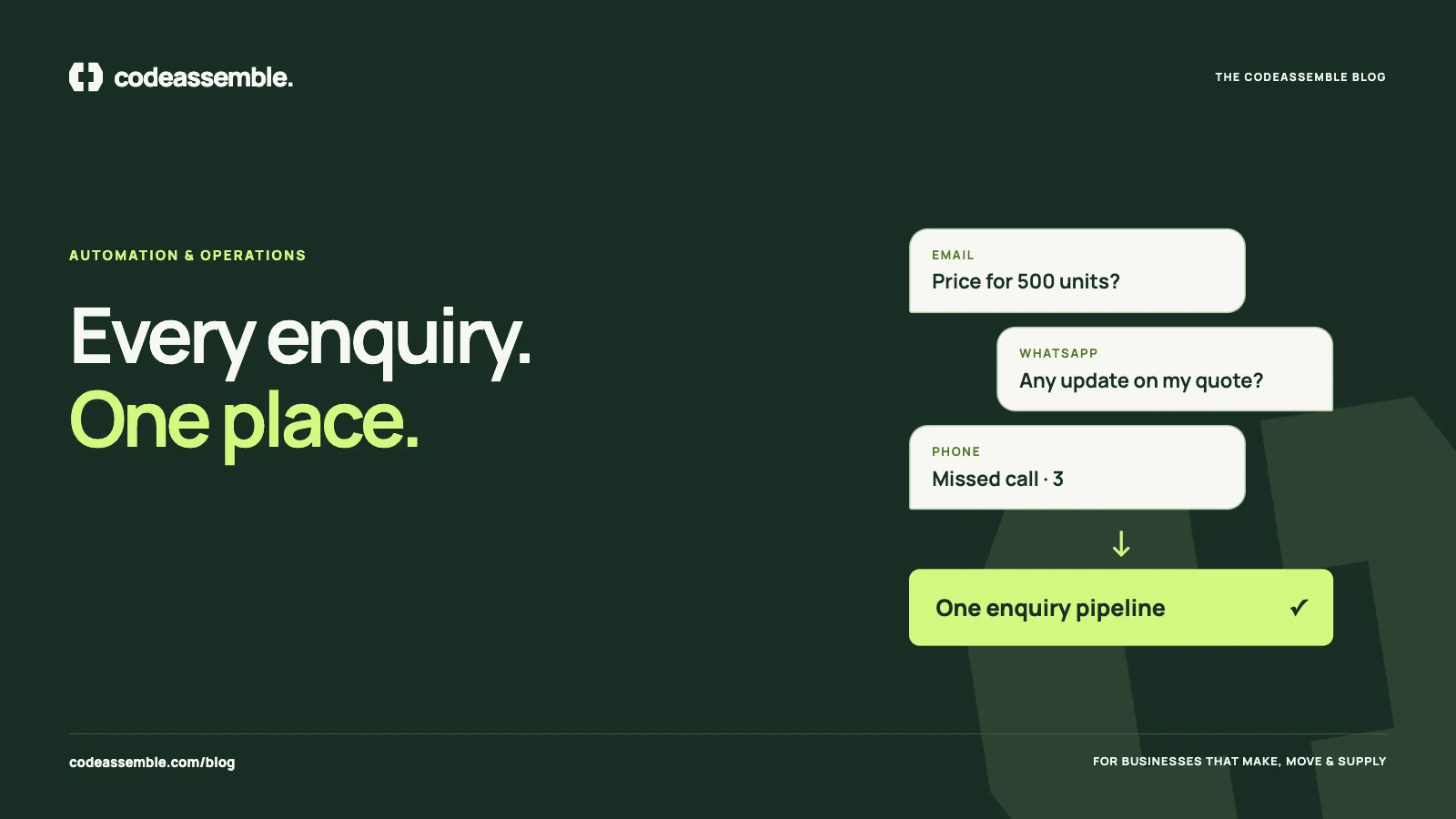
That’s not carelessness. It’s the natural result of enquiries arriving through too many channels: the website form, a shared email address, salespeople’s personal inboxes, WhatsApp, phone calls, trade fair business cards and LinkedIn messages. Each channel works on its own. Together, they create gaps — and leads fall through them.
How leads quietly disappear
Most lost leads aren’t ignored. They’re misplaced. Common scenarios:
- A website enquiry goes to
info@, which three people can see — so each assumes someone else replied - A buyer messages a salesperson on WhatsApp during their holiday, and the chat scrolls out of view
- A form still sends to the email address of an employee who left
- A phone enquiry is noted on paper and never entered anywhere
- A promising lead gets a quote, but nobody follows up when the buyer goes quiet
From the buyer’s side, it looks the same in every case: they asked and nobody answered. They’ve probably asked your competitors too.
Step 1: Decide where every enquiry should live
The first fix isn’t technology. It’s a decision: every enquiry, from every channel, gets recorded in one place.
That place might be a CRM, a simple internal tool or, for a small team, a well-structured shared sheet. What matters is that it’s one place, everyone uses it and each enquiry has:
- Date received and source (website, email, WhatsApp, phone, event)
- Contact and company details
- What they’re asking for
- A named owner
- Current status — new, contacted, quoted, won, lost
- Next action and date
Step 2: Automate the capture you can
Typing every enquiry by hand is exactly the job people skip on busy days. Automate what you can:
- Website forms can create a record directly, with all the details, and notify the owner
- Email enquiries to a sales address can be forwarded into the same system
- WhatsApp Business conversations can be logged with supported tools and integrations
- Phone enquiries can be logged through a quick internal form that takes seconds on a phone
The aim is that recording an enquiry takes less effort than not recording it.
Step 3: Route enquiries to the right person automatically
Routing rules remove the “I thought you had it” problem. For example:
- Export enquiries go to the export manager
- Enquiries for a specific product line go to the relevant specialist
- Large-quantity requests notify a manager as well
- Anything unassigned after a set time triggers a reminder
Simple rules like these can be built into a business automation workflow without changing the tools your team already uses.
Step 4: Acknowledge immediately, respond properly
Two different responses matter:
- An instant acknowledgement, sent automatically, confirming receipt and telling the buyer what happens next
- A real response from a person, within a time your team commits to
The acknowledgement buys you time and reassures the buyer. The real response wins the business. Neither replaces the other.
Step 5: Make follow-up part of the system
Many B2B sales are won on the second or third follow-up, not the first quote. Yet follow-up is the step that most often depends on memory.
Build reminders into the process:
- Quote sent → reminder to follow up after an agreed number of days
- No response after follow-up → move to a nurture list or mark as lost with a reason
- Won → trigger onboarding steps
Recording why deals are lost — price, lead time, specification, no response — gives you valuable information about your market over time.
Step 6: Look at the numbers monthly
Once enquiries are captured in one place, you can answer questions that were guesswork before:
- How many enquiries did we receive, by channel?
- How quickly did we respond?
- Which products or markets generate the most interest?
- What proportion turned into quotes and orders?
These numbers show whether the website is working and where to focus. See how to measure website performance.
Keep people in control
Automation should support your team, not replace judgement. A good setup captures and routes enquiries automatically but leaves qualification, pricing and relationship decisions to people. Plan for exceptions, too: what happens when an integration fails or an enquiry doesn’t fit any rule? It should land somewhere visible rather than disappear.
You don’t need more leads if you’re losing the ones you already get. Start by catching every one.
Where to start
Our business automation projects start with one clearly defined workflow connecting up to two API-ready tools — enquiry capture and routing is often the ideal first project. If you’re not sure how many leads slip through, describe how enquiries reach you today and we’ll help map the gaps.