For many manufacturers and wholesalers, a large part of revenue comes from repeat customers: distributors, dealers, contractors and trade buyers who order regularly. These relationships are valuable. They’re also, often, surprisingly labour-intensive.
Every reorder is an email or phone call. Every price question goes to sales. Every request for an invoice copy, certificate or delivery note goes to accounts. Each one takes a few minutes. Across dozens or hundreds of customers, those minutes become a significant part of your team’s week.
A customer portal changes that.
What a B2B customer portal is
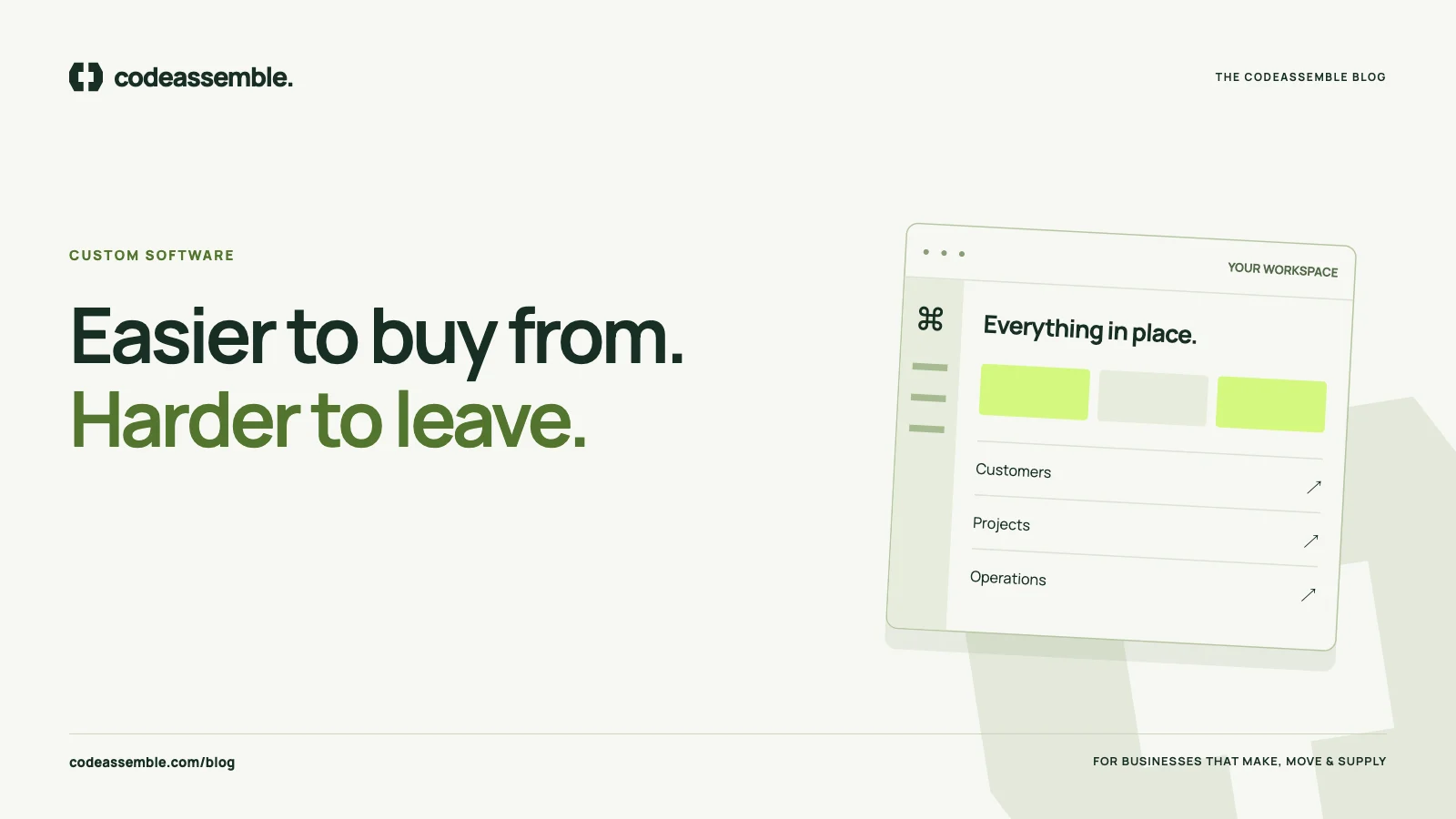
A customer portal is a secure, logged-in area of your website where each customer can see information and take actions specific to their account. Unlike a public online shop, it reflects the reality of B2B relationships: agreed pricing, credit terms, approved products and account history.
Typical features include:
- Account-specific pricing and catalogues
- Quick reorder from previous orders
- Order submission with purchase order references
- Order status and tracking
- Document downloads — invoices, delivery notes, certificates, datasheets
- Account information — statements, balances, credit limits
- Support requests linked to orders or products
What your customers gain
Distributors and trade buyers are busy. A portal lets them:
- Place or repeat orders at any time, in any timezone
- Check prices and availability without waiting for a reply
- Find documents themselves when an auditor or their own customer asks
- See order status without phoning
- Keep a clear history of everything they’ve bought
Being easy to buy from is a real competitive advantage. When two suppliers offer similar products at similar prices, buyers often stay with the one that’s less effort.
What your business gains
Less administrative load
Routine requests — prices, invoice copies, order status — move to self-service. Your team handles exceptions, not repetition.
Fewer errors
Customers select from their approved products and pricing, so orders arrive complete and accurate instead of being re-typed from an email. See the true cost of manual work.
Better insight
You can see what each customer orders, how often and when they’ve gone quiet — useful information for sales.
Scalability
You can serve more customers without adding administrative staff at the same rate.
Stickier relationships
A portal that becomes part of a customer’s routine is a reason to stay.
Does a portal replace your sales team?
No. It frees them. Relationship-building, technical advice, negotiation and new business still need people. A portal removes the routine transactions that get in the way of that work.
Do you need a full e-commerce platform?
Usually not. B2B portals differ from consumer e-commerce in important ways: pricing varies by account, payment is often on credit terms, orders may need approval, and products may be configured or made to order. Forcing these requirements into a consumer shopping platform often leads to workarounds.
A purpose-built portal can be designed around how you actually sell, and connected to your existing accounting, inventory or ERP system where those systems allow.
Start with one valuable feature
A portal doesn’t have to launch with everything. Pick the feature that removes the most routine work:
- If your team spends hours on order status calls, start with order tracking — see stop answering “where’s my order?” calls
- If reorders are re-typed from emails, start with quick reorder
- If accounts constantly resend documents, start with document downloads
Launch it with a few willing customers, gather feedback, then extend.
Questions to answer before you build
- Which customers will use it first, and what do they ask for most?
- Where does the data live today — accounting software, ERP, spreadsheets?
- Who approves new accounts and pricing?
- What should customers see, and what should stay internal?
- How will customers be supported when they first log in?
The easiest supplier to buy from often wins the reorder.
Explore a portal for your customers
We build custom portals and web applications for businesses that want to serve customers better without adding administrative weight. A first release covers agreed user roles and one core workflow. Tell us what your repeat customers ask for most, and we’ll suggest where a portal could start.