When an established business decides to replace its website, one of the first questions is whether to use a template or invest in a bespoke design. Templates look appealing: they’re inexpensive, quick to launch and the demo looks polished. Bespoke websites cost more up front and take longer.
Both have their place. But for B2B businesses that compete on expertise, reliability and specialist products, the comparison isn’t really about design. It’s about fit.
What a template gives you
A template (or theme) is a pre-designed layout you fill with your own content. The advantages are real:
- Lower initial cost
- Faster launch for simple sites
- Familiar editing tools if it runs on a common platform
For a new business with a simple offer, a template can be a perfectly sensible start.
Where templates fall short for B2B businesses
They’re designed for content you don’t have
Template demos are built around beautiful lifestyle photography, short punchy copy and three neat service boxes. A manufacturer with 80 product variants, technical specifications, certifications and multiple industries rarely fits that shape. The result is content squeezed into sections that weren’t designed for it.
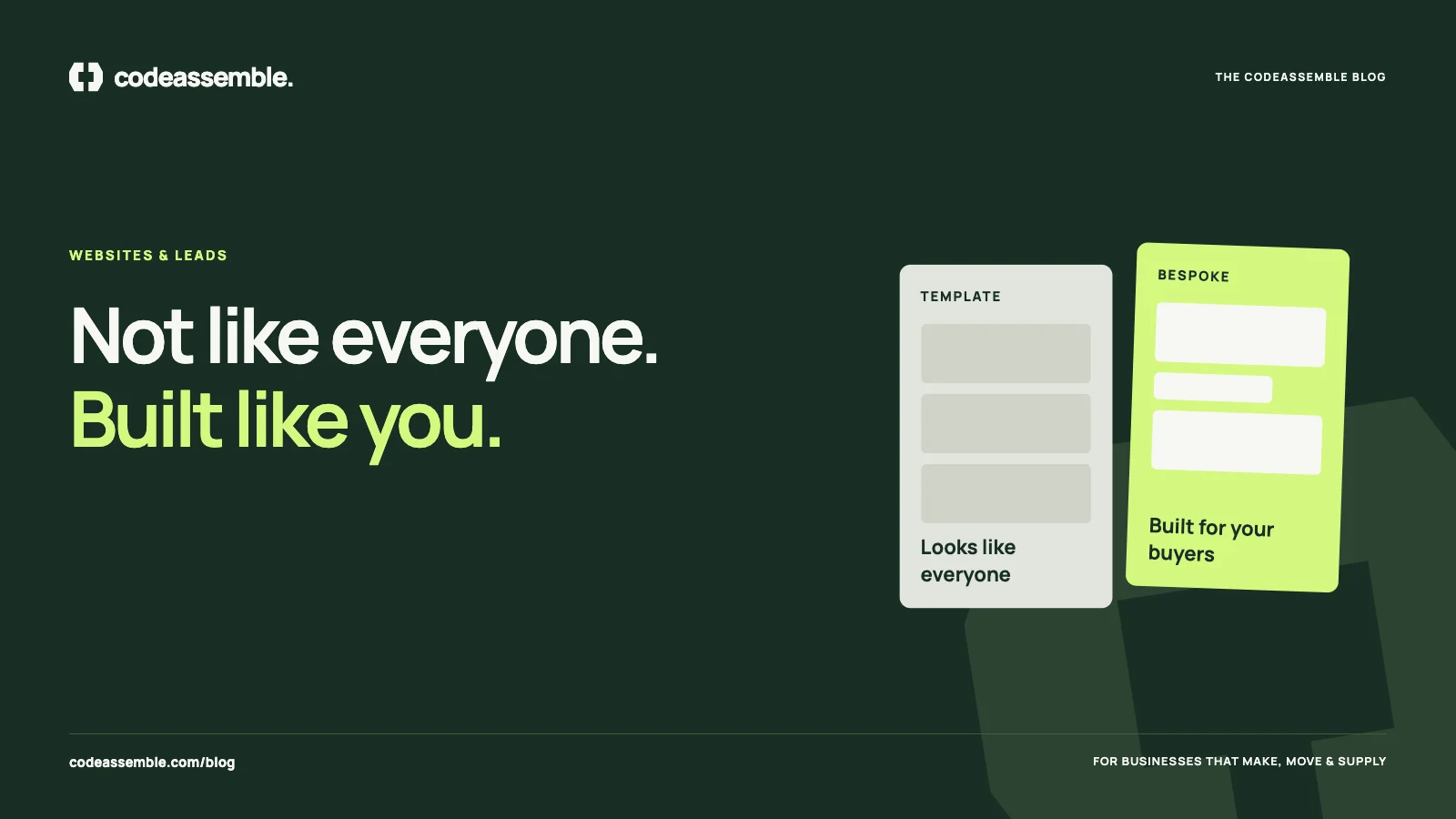
They look like everyone else
Popular templates are used by thousands of websites. When a buyer compares you with two competitors, looking interchangeable doesn’t help — especially when your actual capabilities are very different.
They carry weight you don’t need
To appeal to every possible buyer, templates include sliders, animations, page-builder features and plugins most sites never use. That extra code often slows the site down. See the hidden cost of an old WordPress website.
They’re hard to extend
When you later need a quote basket, a product filter, a CRM integration or a customer login, a template often becomes a constraint. Workarounds accumulate.
What a bespoke website gives you
A bespoke website is designed and built around your business: your buyers, your products, your sales process and your content.
- Structure that fits your catalogue, capabilities and markets
- Messaging and design that differentiate you from competitors
- Enquiry journeys designed around how your buyers ask for prices and samples — see designing a request-for-quote journey
- Performance-conscious code, without features you don’t use
- Room to grow, with integrations and functionality added cleanly over time
A fair comparison
| Template | Bespoke | |
|---|---|---|
| Initial cost | Lower | Higher |
| Time to launch | Faster for simple sites | Planned over several weeks |
| Fit for complex products | Often compromised | Designed for your content |
| Differentiation | Limited | Built around your business |
| Performance | Depends on theme weight | Built for the job |
| Extending later | Workarounds common | Planned in |
| Hidden costs | Plugins, fixes, rework | Clearer, scoped up front |
The real cost question
The useful comparison isn’t “template price vs bespoke price”. It’s “what will this website cost and return over the next several years?”
Consider:
- Rework: how often will you patch or redesign the template site?
- Enquiries: does a clearer, purpose-built site bring more qualified buyers?
- Sales efficiency: does it answer questions your team currently answers by phone?
- Credibility: does it help you win larger, more demanding customers?
For businesses whose average order or customer relationship is substantial, a single additional good customer can outweigh the difference in build cost. We can’t promise that outcome for any particular site — but it’s the right way to think about the investment.
Bespoke doesn’t have to mean enormous
A bespoke website isn’t necessarily a large, expensive project. A focused bespoke site — a handful of well-designed core pages with a clear enquiry route — is often the right first step for an established business. It can grow into a fuller catalogue or connected system later.
Our starting website scope is a focused business website with up to five core pages and supplied content. Larger catalogues, integrations and migrations are scoped individually, and you can see exactly what’s included on our pricing page.
A template makes your website look finished. A bespoke website makes your business look like itself.
See the difference
Take a look at our work for manufacturers and industrial suppliers, then tell us about your business. We’ll tell you honestly whether bespoke is worth it for you — and if a simpler route makes more sense, we’ll say so.