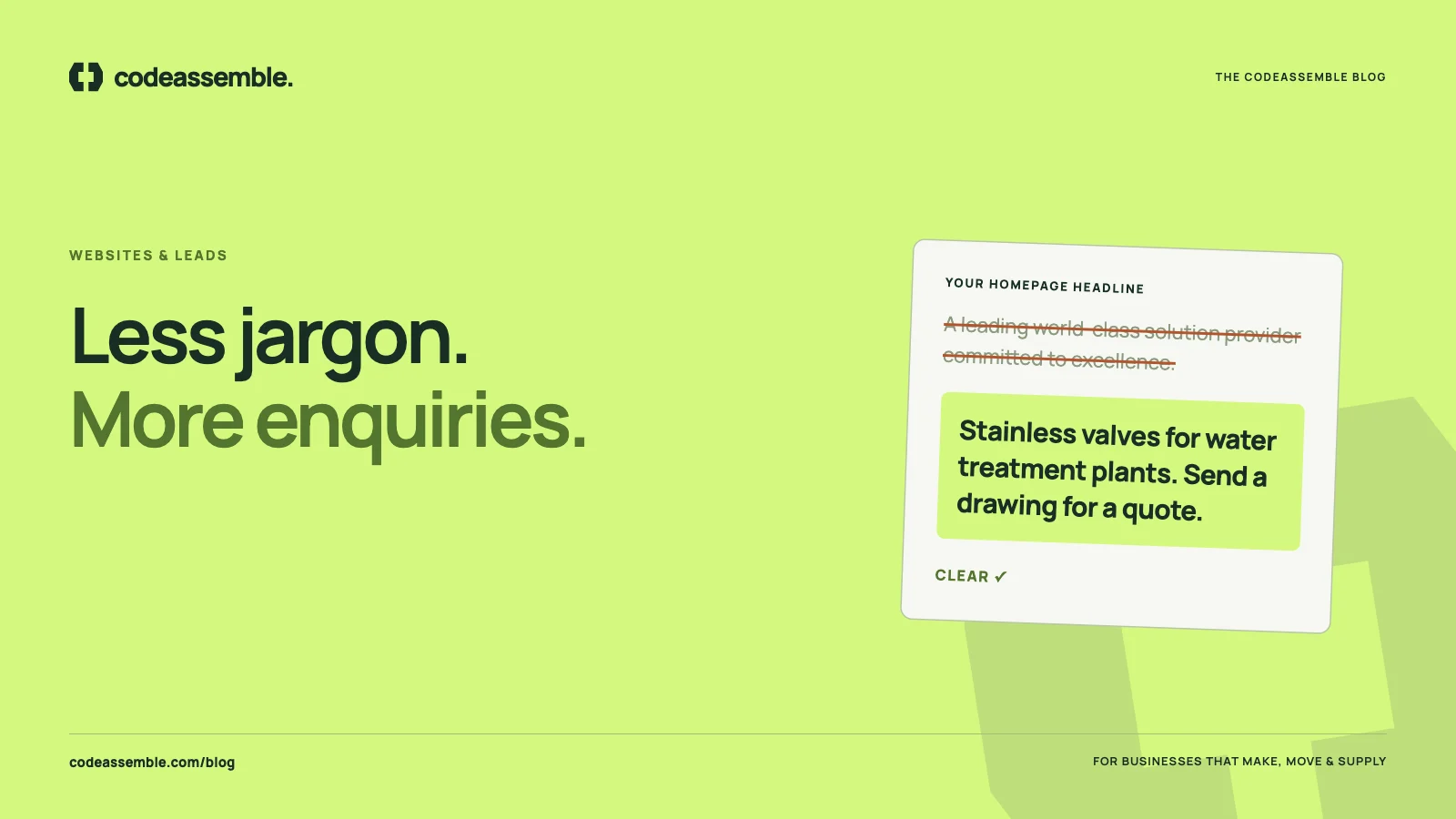
Read the homepages of ten established manufacturers or engineering firms and you’ll find a striking similarity: “a leading provider of quality solutions”, “committed to excellence”, “customer satisfaction is our top priority”, “state-of-the-art infrastructure”.
None of it is false. But none of it helps a buyer decide. Generic copy is one of the most common — and most fixable — reasons B2B websites fail to convert. Here’s how to write copy that works for technical products and the people who buy them.
Why generic copy fails
Technical buyers are pragmatic. They want to know quickly whether you can supply what they need. When every supplier claims excellence, the claim becomes noise. Buyers skim past it, looking for specifics. If they don’t find them, they leave.
Generic copy also makes you interchangeable. If your homepage could belong to any competitor, you’ve given buyers no reason to choose you.
Lead with what you make, for whom
Your homepage headline should answer three questions in a sentence or two:
- What do you make or do?
- Who is it for?
- Why choose you?
Compare:
- Before: “Welcome to ABC Industries — your trusted partner for quality engineering solutions.”
- After: “Precision-machined stainless components for food processing equipment. Made to drawing, inspected before dispatch.”
The second version is less grand. It’s also far more useful — and more likely to make the right buyer keep reading.
Replace claims with evidence
For every claim, ask “how would a buyer know this is true?” Then write that instead.
| Instead of | Write |
|---|---|
| “State-of-the-art facility” | The key machines, capacities and processes you have |
| “Uncompromising quality” | Your certifications, inspection steps and testing |
| “Vast experience” | Years in operation, industries served, project examples |
| “Global presence” | The regions and markets you actually supply |
| “Customer-centric approach” | Response times, named contacts, how you support orders |
Write for two readers at once
B2B purchases often involve more than one person. An engineer cares about specifications and performance. A purchasing manager cares about price, lead time and reliability. A business owner cares about risk and value.
Good B2B copy serves them in layers:
- Headlines and summaries in plain language anyone can understand
- Technical details in tables, specifications and downloads for those who need them
- Commercial information — lead times, order quantities, terms — clearly signposted
Use the words buyers use
Your team may use internal product names, abbreviations or regional terms. Buyers might search with different words. Include common alternative names and generic terms alongside your own. This helps both readers and search engines — see SEO for “boring” industries.
Explain the application, not just the product
Buyers think in problems: “I need to stop water seeping through a crack in a basement wall.” Copy that connects your product to that problem is more persuasive than a list of chemical properties alone. Include application pages, use cases and examples showing where and how products are used.
Make every page end with a next step
Each page should guide the reader towards an action that fits what they’ve just read:
- After a product description: Request a quote for this product
- After a technical guide: Download the datasheet or Ask an engineer
- After a case study: Discuss a similar project
See why your B2B website isn’t generating leads for more on next steps.
Practical writing tips
- Short sentences. Especially for international readers reading in a second language.
- Active voice. “We test every batch” beats “every batch is tested”.
- Specific numbers where you can verify them.
- Plain words. “Use” rather than “utilise”; “help” rather than “facilitate”.
- Scannable structure. Clear headings, short paragraphs, bulleted lists and tables.
- Consistency. The same product name and specifications everywhere.
Test your copy with one question
Read each key page and ask: “Could a competitor put their logo on this without changing a word?” If the answer is yes, it needs rewriting.
Clear copy doesn’t make a technical business sound simpler. It makes it sound confident.
Words and website, together
Copy and design work best when planned together. In our bespoke website projects, we structure your pages around the buyer’s questions and help shape messaging that reflects your real strengths. Share your current homepage with us and tell us what makes your business different.